
Collin County attics, additions and steel shops
Spray Foam Insulation in McKinney, TX
Foam where it earns its cost, blown-in where it does the job for less, and every area priced on paper.
- Free estimates at your home, not over the phone
- Quotes that list foam type, depth and R-value for each area
- Open-cell, closed-cell and blown-in, matched to the spot
Insulation Built for McKinney Summers
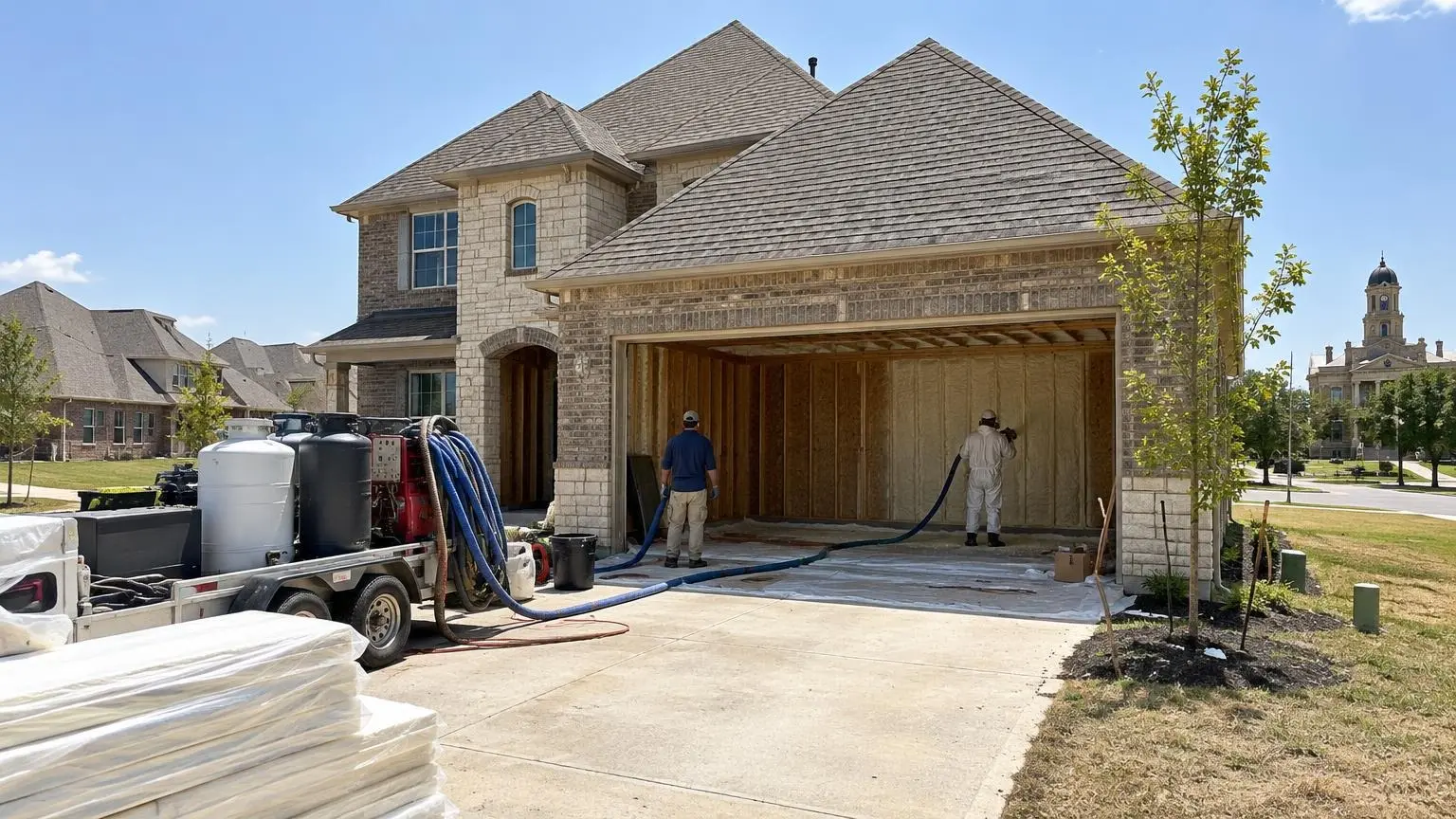
Spray foam insulation in McKinney earns its keep from June through September. The McKinney climate table on Wikipedia, built from NOAA data, puts average daily highs at 92.7F in July and 92.6F in August, and humid air makes those afternoons feel hotter. A house loses that fight in the attic first: heat soaks through the roof, warm air pushes in through gaps in the ceiling, and the ducts carrying your cooled air run right through it. We seal those gaps and insulate attics, walls, raised floors, garages and metal buildings across McKinney and central and eastern Collin County, choosing open-cell foam, closed-cell foam or blown-in for each spot based on what it needs to do.
Winter still counts
The same table lists a record low of -7F and January nights that average 31.1F. Most winters are mild, but a tight, well insulated house holds heat far longer during a hard freeze or a power outage, and pipes near the attic and exterior walls are slower to freeze. Air sealing that keeps August heat out keeps February heat in.
What code your house was built to
OpenEI's county list places Collin County, and Grayson County to the north, in IECC Climate Zone 3A. Texas has required at least the 2015 IRC energy chapter statewide since September 1, 2016, and that edition calls for R-38 in Zone 3 ceilings. The 2021 IECC raised the base-table ceiling to R-49 for the zone. McKinney has moved further still: the city's inspections page says the City Council approved the 2024 International Residential Code and 2024 IECC, with amendments, on October 1, 2025. A McKinney house finished in 2012, one finished in 2022 and one permitted this year may have been insulated to three different targets, which is why we measure what is in your attic instead of assuming.
Closed cell vs open cell
Open-cell foam is light and spongy. HomeGuide puts it at R-3.5 to R-3.7 per inch. It swells to fill a cavity, stops air movement and costs less, so it is the usual pick for the underside of a roof deck or for interior walls where sound matters. Closed-cell foam is hard and dense, R-5 to R-7 per inch by HomeGuide's figures, and at normal thickness it also slows water vapor. We use closed-cell where depth is tight, on steel buildings, on the underside of raised floors and on rim areas. Your quote says which foam goes where and why.
Spray foam or blown-in?
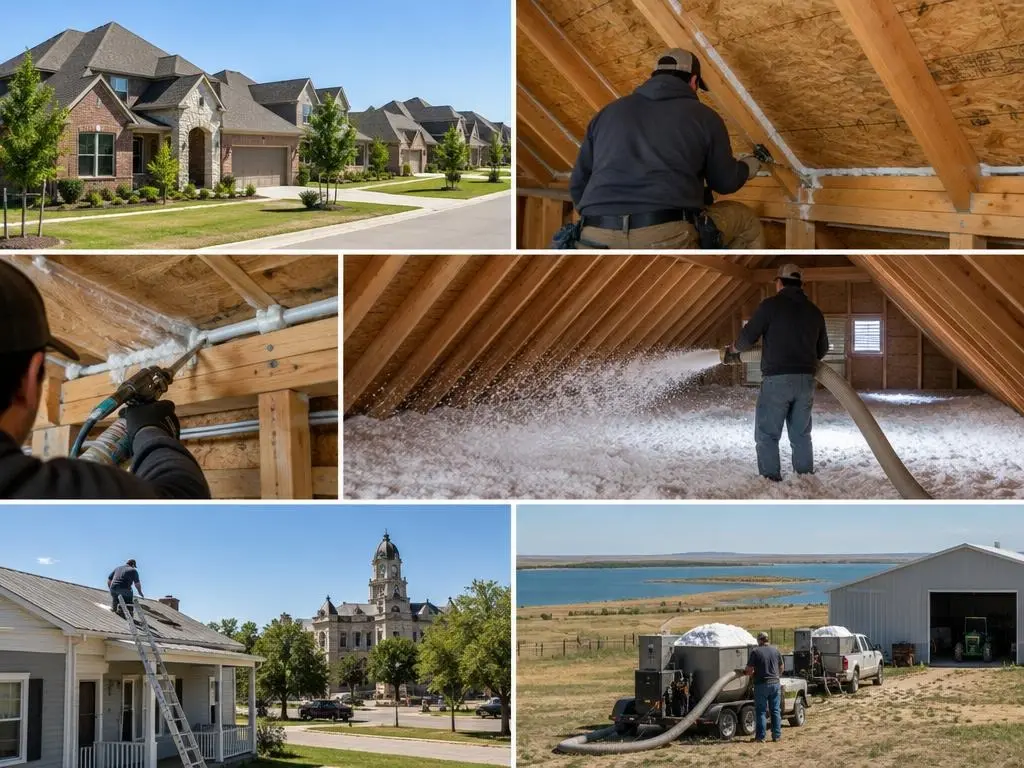
People in McKinney ask this one constantly, and the honest answer is that it depends on the attic. If the attic is vented and the ducts are short and tight, sealing the ceiling and blowing loose-fill to a deep, even layer is often the better value. If the air handler and long duct runs live up there, moving the insulation to the roof deck with foam brings that equipment inside the insulated shell. We price both when both make sense, side by side.
Spray foam insulation cost
HomeGuide's 2026 cost guide lists installed spray foam at $1.50 to $5.00 per square foot: $1.50 to $3.50 for open-cell and $3.00 to $5.00 for closed-cell. It puts roughly 1,000 square feet at $1,500 to $5,000, a whole house at $8,000 to $20,000, and a typical job minimum at $1,000 to $2,000 or more. Fixr's 2025 guide quotes $3.15 to $7.50 per square foot for existing walls and $2.75 to $6.50 for new construction. Blown-in runs $1.00 to $2.80 per square foot in HomeGuide's numbers. In McKinney, the roof shape moves the number more than anything else: a two-story house with several hips, valleys and dormers has far more deck to cover than a simple gable roof of the same floor area. Treat these as national planning figures; the price on your written estimate is what you pay.
Oncor's efficiency program
If Oncor delivers your electricity, its Home Energy Efficiency Program can pay incentives on attic, wall and floor insulation. Oncor pays those incentives to approved participating service providers, not to homeowners, and its insulation page says 2026 funding is fully used up, with an update expected in January 2027. We will tell you plainly whether a program applies to your job when we quote it.
Picking insulation contractors and spray foam companies
There are plenty of spray foam insulation contractors and general insulation companies working Collin County, and the quotes you collect may be hard to line up. Ask each one which product goes on which surface and at what thickness. Ask what R-value that gives. Ask how they deal with the attic vents and any gas appliances if they seal the attic, and what ignition or thermal barrier exposed foam needs; McKinney's residential paperwork packet includes a spray foam letter covering the ignition barrier for the inspection. Ask how long you need to be out of the house; HomeGuide's guidance is at least 24 hours. If someone searching for spray foam insulation near me gets a single lump-sum number with no depth or R-value, that is the quote to question.
Our Services
Six services covering the attic, the walls, the floor, the shop and the cleanup.
Spray Foam Insulation
Open-cell and closed-cell foam for roof decks, walls, floors and steel, chosen surface by surface.
Learn more →Attic Insulation & Air Sealing
Sealing the leaks between the house and the attic, then bringing blown-in or foam up to a full, even depth.
Learn more →Wall Insulation
Foam or dense-pack in exterior walls during additions, remodels and new builds, and options for closed walls.
Learn more →Crawl Space & Raised Floor Insulation
Closed-cell foam and sealing under pier-and-beam floors, so cold floors and humid crawl spaces stop bothering the house above.
Learn more →Metal Building & Shop Insulation
Closed-cell foam for steel shops, barns, garages and workshops, to cut heat gain and stop dripping condensation.
Learn more →Insulation Removal & Replacement
Vacuuming out wet, crushed, smoke-damaged or pest-fouled insulation and putting a clean, sealed layer back in.
Learn more →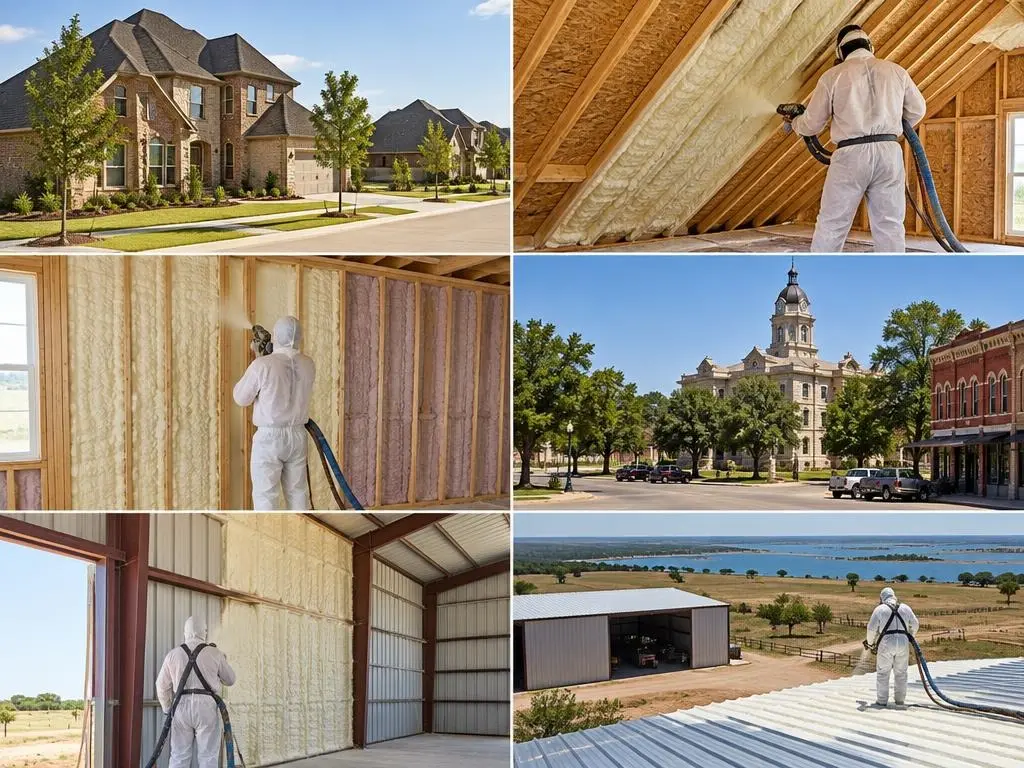
Common Questions
Is spray foam or blown-in better for a McKinney attic?
It depends on where your HVAC equipment and ducts are. With equipment in the attic, foam on the roof deck usually helps more; with a simple vented attic and short ducts, sealing the ceiling and blowing in a deeper layer is often the better buy. We price both when both fit.
How much does spray foam insulation cost in McKinney?
HomeGuide's national range is $1.50 to $5.00 per square foot installed, with whole houses at $8,000 to $20,000. Roof shape, foam type and thickness drive your number, and the written estimate after our visit is your price.
Can you spray foam inside existing walls?
Open-cavity spray foam needs the drywall off, so in finished walls we usually wait for a remodel or addition. Closed walls can sometimes be filled another way, and we will tell you what fits your house.
What R-value should a McKinney attic have?
Collin County is in Climate Zone 3A. The 2015 Texas minimum calls for R-38 in ceilings, and the 2021 IECC base table calls for R-49. We measure what you have and quote the depth to reach your target.
Do I have to leave the house when you spray?
Yes, for foam. HomeGuide advises staying out at least 24 hours while it cures, and we schedule around that. Blown-in work does not require you to leave.
Does Oncor pay for insulation?
Oncor's Home Energy Efficiency Program pays incentives through approved participating providers, not directly to homeowners, and its page says 2026 funds are used up. We will tell you at the estimate whether any program applies.
Will spray foam hurt my home's value?
Foam on a roof deck or in walls is a permanent part of the house, so buyers and inspectors will ask what was installed and whether the attic was sealed correctly. A written record of the product, thickness and ignition barrier answers those questions.
Why Homeowners Call Spray Foam Insulation McKinney
We price each area separately
Attic, walls, garage and shop each get their own line, with material, depth, R-value and cost, so you can phase the work.
We check before we spray
Roof leaks, wet decking, damaged ducts and gas appliance venting are looked at first, because foam should not cover a problem.
We are straight about cheaper options
When sealing plus blown-in gets you most of the way for less, it goes on the quote next to the foam option.
We plan around the cure
Foam work is scheduled for a time the house can be empty, and we tell you when it is safe to come back.
Where We Work
We work in McKinney and the cities and towns around it in central and eastern Collin County, plus Van Alstyne just over the Grayson County line and Sachse where Collin meets Dallas County. The mix changes as you drive. Plano boomed from the 1970s on, and Murphy and Sachse filled in mostly after 2000; in those subdivisions attic sealing and blown-in top-ups do a lot. Melissa, Princeton and Lavon have filled with brand-new houses, where the questions are about bonus rooms and builder-grade attics. Fairview, Lucas and Parker spread fewer homes over more land, some with a detached shop or barn. Van Alstyne, founded along the railroad in 1873, and Farmersville, once a major onion shipper, keep older downtowns with new streets growing around them. Every town page below covers what is specific to that place.
- Spray Foam Insulation in McKinney, TX
- Spray Foam Insulation in Allen, TX
- Spray Foam Insulation in Fairview, TX
- Spray Foam Insulation in Lucas, TX
- Spray Foam Insulation in Parker, TX
- Spray Foam Insulation in Melissa, TX
- Spray Foam Insulation in Princeton, TX
- Spray Foam Insulation in Wylie, TX
- Spray Foam Insulation in Murphy, TX
- Spray Foam Insulation in Sachse, TX
- Spray Foam Insulation in Lavon, TX
- Spray Foam Insulation in Farmersville, TX
- Spray Foam Insulation in Plano, TX
- Spray Foam Insulation in Van Alstyne, TX
Get a Spray Foam Insulation Estimate
We look at the attic first and put each option in writing.